


Secret Scottish Factory to Power UK Medicine

A new economic development project initiated by Breathe Life Sciences in the Scottish Borders region involves beginning work on a high-security medicinal cannabis production facility.
As part of a strategy which combines business ambition with secrecy, this facility will be constructed with its location masked in order to keep highly valued pharmaceutical stock a secret.
The facility is projected to generate up to 100 specialized jobs over a period of three years, with an initial batch of 36 employees currently being recruited. The new facility will specialize in producing patient-ready medicinal cannabis products, which is a step in localizing the value chain to serve the increasing patient population in the UK.
The project demonstrates how quickly the UK has grown from a purely import-driven market to a domestic producer.
With over 80,000 patients actively being prescribed cannabis for a variety of ailments, including chronic pain and epilepsy, the need for quality medicine has never been more prevalent.
With a finance investment of nearly £850,000 from South of Scotland Enterprise, this facility is a major boost to the sector.
It shows that regional authorities have moved beyond the negative connotation of cannabis and have come to see it not only as a new vertical in life sciences but also a driver of jobs and technological change in regional centers.
Source: Daily Business Group
The Great Workforce Recalibration of 2025

The Vangst 2025 Jobs Report is a sobering and optimistic take on the future of a stable cannabis market in America.
For the first time, a small fall in total employment was recorded, down 3.4% to a level of approximately 425,000 in full-time employment.
This is happening despite a boost in legal sales to over $30 billion, which represents a definite rejection of a “grow at all costs” mentality in favor of a more measured approach.
Companies are not speculatively hiring anymore; rather, companies are optimizing, automating low-level work, and prioritizing profit over headcount. “Strategic reset” is a milestone in this industry’s evolution towards a mature Consumer Packaged Goods industry.
Conversely, in established markets such as California and Colorado, jobs are being lost because of market maturity and taxes, but a “second wave” of jobs in newly legal markets is bursting forth, with hiring taking place in earnest in states such as Ohio, New York, and Maryland, which have become hubs of employment.
The information available suggests a increasingly distant horizon for easy access to lower-level employment but an all-time high level of demand for skilled and specialized people in roles such as Extraction Technologists and Compliance Officers.
With this bifurcation of the market, a very distinct path is established for applicants in terms of employment: in order to survive in this cannabis industry, one must have mobility and specialize.
Source: Vangst
Breaking the Opioid Cycle: Clinical Proof
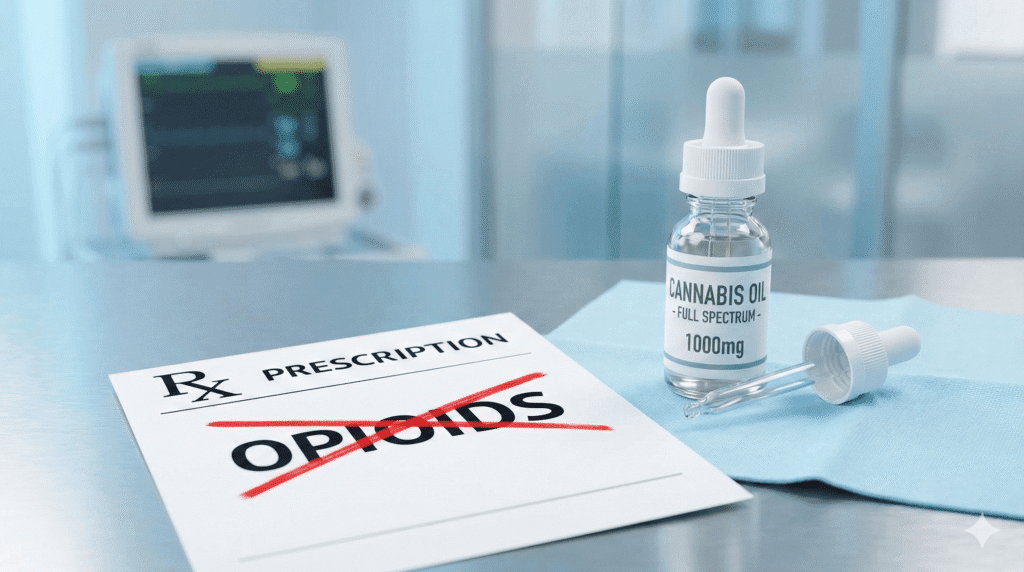
A major study released in JAMA Internal Medicine in December 2025 has offered some of the most compelling medical evidence yet of a definite reduction in prescription painkiller usage with medical marijuana.
A study conducted on adults with chronic pain in the New York State Medical Cannabis Program, led by Albert Einstein College of Medicine, proved conclusive when patients reduced their daily opioid intake by 22% after using medical cannabis, which was administered under pharmacist guidance, over an 18-month period.
Not only that, those patients who were consistently adherent with their cannabis prescriptions used significantly less morphine equivalent than others.
The significance of this study is it shifts the “exit drug” theory from anecdotal experience to published research.
Unlike previous studies which took a self-reported assessment, this study based its research on hard facts from the State Prescription Monitoring Program, providing irrefutable evidence of the “substitution effect.” For policymakers and insurance companies, this information is a game changer.
It proposes that making medical cannabis a part of pain treatment plans is not a matter of patient preference but a way to address the opioid epidemic in public health.
They concluded that a gradual cut in opioid consumption, which is aided by cannabis, can provide a safer and more preferable option for chronic pain patients.
Source: Mirage News / JAMA Internal Medicine
Consensus Reached on Cannabis and Cancer

And in what is being labeled a record study of its kind, a massive meta-analysis conducted in Frontiers in Oncology shows that over 10,000 scientific articles have been reviewed in order to find a consensus on cannabis and cancer.
The findings, widely reported in 2025, were a surprise in their intensity: “there is overwhelming scientific support” for cannabis not simply as a palliative aid for nausea and pain relief but potentially as a direct anti-cancer treatment, with 75% positive consensus.
The research used sophisticated data analysis, which removed all bias, to show a remarkable level of consensus among the scientific community on this question, which has been continually ridiculed by so many.
The study concluded that cannabis is simply unbeatable in its efficacy in dealing with “triad” symptoms of cancer suffering, such as inflammation, loss of appetite, and nausea induced by chemotherapy. The most “shocking” revelation, however, is how much evidence supports the belief that cannabis can cause apoptosis (cell death) in cancerous tissue and prevent its proliferation.
Although these authors state a need for further large-scale human testing in order to isolate a precise formula, they clearly state a current level of evidence sufficient to reassess cannabis as an established ancillary treatment within oncology. (Rick Simpson, anybody?)
This report defies conventional medical boards’ caution and puts patients in the hot seat with information meeting or exceeding standards established for new drugs.
Source: The Guardian
The Silver Era: Veterans Leading the Shift

The month of December 2025 brings attention to one of the most rapidly growing populations in the cannabis industry: senior citizens. A new report launched by the Department of Veterans’ Affairs and studies published in JAMA Network Open illustrate a dramatic change in culture and medicine among this population.
The statistics show a staggering 10% plus of senior veterans using cannabis, which is twice as much as in the senior non-veteran population. Furthermore, this usage is not recreational in nature but is a direct result of utilizing cannabis to alleviate chronic pain, sleep disorders, and anxiety issues in order to substitute “cocktails” of geriatric drugs, which come with debilitating side effects.
Nevertheless, not all news is good news. The studies have concluded that a concerning amount of this population is developing a dependency, up to a third in part because they have not been educated on how to take the medication properly.
This has ignited a debate in the country concerning the need for “senior-specific” guidance.
The narrative in this case is one of empowerment and vulnerability. A generation of people who previously demonized this drug are embracing it in order to reclaim their life but are doing so without medical guidance.
It highlights the need for healthcare systems to come up to speed with regards to their senior patients and allow safe usage of cannabis without judgment.
Source: News-Medical / JAMA Network Open